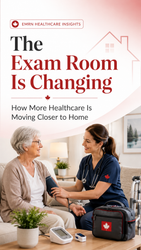
The Exam Room Is Changing: How More Healthcare Is Moving Closer to Home in Canada
Posted by Mark B on 20th Aug 2026
For generations, the hospital has been the image most people associate with healthcare. But the modern healthcare system is much broader.
A patient may have surgery at a hospital, recover with support at home, visit a community clinic for follow-up care and use monitoring equipment between appointments. Seniors may receive ongoing support without moving into a hospital or long-term care setting. Diagnostic testing that once required an inpatient stay may increasingly happen on an outpatient basis.
This change matters for healthcare organizations, caregivers and medical supply purchasers because care delivered in different settings requires a different approach to equipment, portability, replenishment and usability.
According to the Canadian Institute for Health Information (CIHI), approximately 81% of households receiving home-care services said those services were very helpful in allowing the recipient to remain at home.
Healthcare Is Becoming Less About One Place
"Healthcare facility" once made people think primarily of hospitals and doctor's offices.
Today, care may be delivered across a much larger network:
Community Clinics
Primary care, walk-in services, specialty care and routine patient assessment.
Outpatient Care
Procedures, monitoring and follow-up without an overnight hospital stay.
Long-Term Care
Ongoing clinical and daily-living support for residents with more complex needs.
The Home
Recovery, mobility support, personal care and ongoing management outside an institution.
CIHI notes that home care in Canada includes short-term support after surgery or acute illness, longer-term support for people managing chronic conditions, rehabilitation and other specialized programs.
Instead of asking only “What does the hospital need?” healthcare purchasing increasingly asks “Where will the patient be cared for next?”
That shift can influence everything from equipment size and portability to packaging, replacement supplies and ease of use.
Equipment Has to Travel With Care
A device that remains permanently mounted in one hospital room solves a very different problem from equipment used between examination rooms, transported by a community healthcare professional or used during home care.
Compact diagnostic tools can help make assessment possible in more settings. Blood pressure monitors, pulse oximeters, thermometers and other portable devices are examples of equipment categories that can support care beyond a traditional hospital department.
Monitoring Can Follow the Patient Outside the Clinic
Some health measurements become more useful when they are not limited to the few minutes a patient spends inside an examination room.
Ambulatory blood pressure monitoring is a good example. A portable system can collect readings over an extended period while a patient goes through normal daily activities.
EMRN's SA-10 Ambulatory BP Monitor, for example, is designed for 24-hour ambulatory blood pressure monitoring and includes programmable measurement intervals and analysis capabilities for professional healthcare environments.
Explore the SA-10 Ambulatory BP Monitor →Discharge From Hospital Does Not Mean Care Has Ended
Leaving the hospital can simply represent a transition from one care environment to another.
Depending on an individual's needs and healthcare provider's instructions, recovery at home may involve mobility support, dressing changes, personal care, respiratory products, monitoring equipment or other medical supplies.
This makes continuity important. The products used after discharge need to make sense for a setting that may not have the storage space, equipment infrastructure or staff resources of a hospital.
Explore EMRN Home Care Solutions →Consumables Matter Just as Much as Equipment
Portable medical devices tend to get attention because they are easy to see. But recurring medical supplies are equally important when care is spread across multiple locations.
Wound dressings, gloves, cleansing products, respiratory accessories and other consumables may need to follow the patient's care plan between healthcare settings.
For example, non-adhering dressings such as Adaptic™ are designed to help protect a wound while minimizing adherence during dressing removal.
View Adaptic™ Non-Adhering Dressings →Sometimes the Most Important Medical Equipment Does Not Look Medical
Supporting care at home is not limited to diagnostic devices.
Walking aids, bathroom safety products, patient-care supplies and durable medical equipment can help make the home environment better suited to recovery and ongoing care.
This reflects one of the biggest differences between institutional care and home care: the patient's everyday environment becomes part of the care environment.
Browse Home Care & Daily Living Solutions →Canada's Population Is Aging
The shift toward home, community and long-term care is especially important as Canada's population gets older.
CIHI reports that more than one in five Canadians is expected to be age 65 or older by 2030. As Canadians live longer, the healthcare system must support different levels of care in the right setting at the right time.
That makes products supporting mobility, monitoring, daily care, recovery and independence increasingly relevant not only to hospitals, but to long-term care organizations, community providers, caregivers and families.
Products Need to Fit the Place Where Care Happens
Moving care beyond the hospital can change what healthcare organizations consider when selecting medical equipment and supplies.
Portability
Can equipment move easily between rooms, facilities or care environments?
Usability
Is the product appropriate for the people and healthcare environment in which it will be used?
Replenishment
What consumables, accessories or replacement components will be required over time?
Environment
Does the product make sense for a hospital, clinic, long-term care facility or home?
Medical supplies increasingly need to serve an entire continuum of care.
EMRN supplies medical equipment and healthcare products for clinics, EMS, hospitals, long-term care, businesses, home care and other healthcare environments across Canada.
Frequently Asked Questions About Home & Community Healthcare
What is home and community care?
Home and community care includes healthcare and support services delivered outside traditional inpatient hospital environments. Depending on the program and individual needs, this can include nursing, rehabilitation, recovery support, personal care and other services delivered at home or in community settings.
What medical equipment is commonly used for home care?
Needs vary by patient and care plan. Home-care equipment may include mobility aids, bathroom safety products, patient-care supplies, monitoring equipment, durable medical equipment and other products recommended by the appropriate healthcare professional.
Why is portable medical equipment becoming more important?
Portable equipment can support healthcare workflows that take place across multiple examination rooms, outpatient facilities, community settings and other care environments rather than remaining permanently installed in a single location.
Where can Canadians buy home-care medical supplies?
EMRN Medical Supplies offers home-care products, durable medical equipment, patient-care supplies, mobility solutions, diagnostic products, wound-care supplies and other healthcare products with Canada-wide service.
Does EMRN supply healthcare organizations as well as individual customers?
Yes. EMRN serves clinics, EMS organizations, hospitals, long-term care, businesses, home-care customers and other healthcare organizations, with quote and bulk-purchasing options available for eligible orders.
The future of healthcare isn't one building. It's a connected network of care.
Explore medical equipment, patient-care products, home-care supplies, diagnostic products and healthcare essentials available from EMRN across Canada.
Explore EMRN Medical Supplies