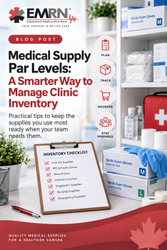
Medical Supply Inventory Management: How to Set Par Levels for Clinics
Posted by Mark m on 24th Sep 2026
Good medical supply inventory management is not simply about keeping the supply room full.
The more useful goal is to keep the right quantities of the right products available when staff need them. That sounds straightforward, but medical inventory can quickly become difficult to manage when a facility uses hundreds of products, multiple sizes, different package quantities and several storage locations.
One practical approach is to establish a par level for frequently purchased supplies. Instead of waiting until an item is almost gone, staff have a predefined quantity that helps determine when and how much to reorder.
This guide explains how clinics, physician offices, long-term care facilities, workplaces and other organizations can use par levels to create a more organized and repeatable medical supply ordering process.
What Is a Medical Supply Par Level?
A par level is a target quantity of inventory that an organization aims to keep available for a particular product. When stock falls below the organization's chosen level, it becomes a signal to review or reorder the item.
Identify the Medical Supplies Your Team Uses Most Often
There is usually no need to create an elaborate inventory system for every product on day one. Start with the supplies that have the greatest impact on daily operations.
These may include examination gloves, gauze, dressings, medical tape, disposable patient-care products, infection-control supplies and other frequently consumed items.
Products consumed throughout a normal workday.
Gloves, dressings and other products that need separate counts by size.
Supplies staff depend on to complete routine procedures.
Treat Each Size, Configuration and Package as Its Own Item
One of the easiest inventory mistakes is counting a product category rather than the exact products being used.
For example, seeing ten boxes of examination gloves does not necessarily mean glove inventory is healthy. If nine boxes are one size and the size used most frequently has only one box remaining, a shortage may still be approaching.
Record details that distinguish one inventory item from another:
“How many do we have?”
It is “How many do we normally need before the next order arrives?”
Set a Practical Par Level Based on Real Usage
A useful par level should reflect how quickly your organization consumes a product and how frequently orders are normally placed.
Rather than choosing an arbitrary quantity, review recent usage and purchasing history. If a clinic consistently uses several boxes of a particular item between orders, the target stock level should account for that pattern.
How much of the product is normally consumed?
How often does your organization normally place an order?
How much stock may be used while replenishment is on the way?
Determine whether additional backup stock makes sense for the item.
Par levels should be reviewed periodically. Changes in patient volume, staffing, procedures or purchasing frequency may change the appropriate quantity over time.
Create a Reorder Point Before Inventory Reaches Zero
Waiting until the last package is opened can turn normal replenishment into an urgent order.
A reorder point gives staff a predefined trigger for taking action. When available inventory reaches that point, the product is added to the next order or reviewed by the person responsible for purchasing.
A clinic normally keeps 12 boxes of a frequently used product.
Instead of waiting until only one box remains, the clinic might establish an internal reorder point that provides enough inventory to cover normal usage during the purchasing and delivery cycle. The exact quantity should be based on the facility's own usage and ordering process.
```Medical Supply Categories Worth Tracking Separately
Breaking inventory into logical categories can make counting, ordering and storage easier to manage.
Kits, refills and frequently replaced first aid products.
Wound CareDressings, gauze, medical tape and related products.
Exam GlovesTrack each commonly used glove size separately.
Infection ControlProducts used across treatment and shared areas.
DiagnosticsEquipment, accessories and replacement components.
Nursing SuppliesEveryday patient-care and disposable supplies.
Give Every Frequently Used Supply a Consistent Location
Inventory data is much more useful when staff know where inventory is located.
If the same product is scattered across multiple cabinets, offices and treatment rooms without a defined system, staff may reorder something that is already available elsewhere or assume stock is sufficient when the main supply location is nearly empty.
Use clear, consistent product locations.
Make backup quantities easy to identify and count.
Record where each product is normally stored.
Record SKUs and Package Details Before the Next Order
Repeat purchasing becomes much faster when the exact product information is already documented.
Instead of writing “order more gauze” or “need gloves,” record the manufacturer's item number or SKU, size, package quantity and preferred product information where appropriate.
A simple inventory record may include:
A Simple 5-Step Medical Inventory Routine
A consistent process can be more valuable than an overly complicated inventory system.
```Count
Review the exact item and available quantity.
Compare
Compare current stock with the chosen target level.
Reorder
Add items below the reorder point to the purchasing list.
Receive
Put replenishment into the correct storage location.
Review
Adjust target levels when normal usage changes.
7 Medical Supply Inventory Mistakes to Avoid
Small inventory habits can have a large effect on how easy it is to keep supplies available.
Make recurring medical supply orders easier to manage.
Keeping preferred SKUs, package quantities and normal order amounts organized can simplify repeat purchasing for clinics, healthcare facilities, workplaces and other organizations.
Explore Business Medical Supplies ```Build a more predictable medical supply ordering routine.
EMRN supplies healthcare organizations, clinics, EMS teams, long-term care facilities, businesses and workplaces across Canada with first aid, nursing, diagnostic, wound care, infection-control, PPE and emergency medical supplies.
```Frequently Asked Questions About Medical Supply Par Levels
What is a par level for medical supplies?
A par level is a target inventory quantity an organization chooses to maintain for a product. It can help staff recognize when stock is running below the quantity normally needed for routine operations.
How do you determine a medical supply par level?
Organizations can review normal product usage, ordering frequency, expected replenishment time, storage capacity and the importance of the item to determine a practical target quantity.
What is the difference between a par level and a reorder point?
A par level generally represents a target inventory quantity, while a reorder point is a quantity that triggers purchasing activity. An organization may use both as part of its internal inventory process.
Which medical supplies should be tracked by par level?
Frequently used consumables and workflow-critical supplies are often good places to begin. The appropriate products will depend on the facility's services, usage patterns and internal inventory procedures.
How often should medical supply par levels be reviewed?
Organizations may want to review target quantities periodically and whenever normal usage, patient volume, purchasing schedules or operational needs change significantly.
Where can Canadian clinics order medical supplies online?
EMRN offers medical supplies for clinics, healthcare facilities, EMS teams, long-term care organizations, businesses and workplaces across Canada, including first aid, nursing, diagnostics, wound care, PPE and infection-control supplies.
Keep the supplies you use most ready when your team needs them.
Establish clear product records, practical stock levels and consistent reorder points, then explore EMRN's selection of medical supplies for healthcare organizations and businesses across Canada.
Explore EMRN Medical Supplies ```