Product details
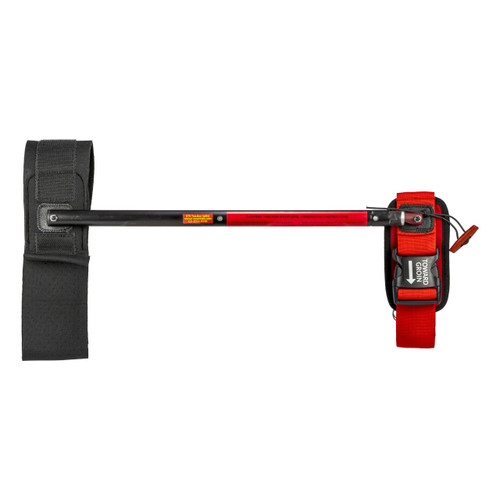
The Slishman Traction Splint (STS) – Original Generation (10-0262) is a compact, lightweight traction splint designed for rapid and effective stabilization of suspected femur fractures in prehospital and tactical environments. Engineered for EMS professionals, military medics, and search-and-rescue teams, the STS delivers reliable mechanical traction while remaining easy to deploy in confined or austere settings.
Unlike traditional traction splints, the Slishman Traction Splint features a streamlined, one-piece design that allows for quick application without complex assembly. Its rugged construction provides dependable durability in field conditions while remaining lightweight enough for inclusion in trauma bags and rescue kits.
The STS is suitable for use on both adult and pediatric patients and is designed to accommodate unilateral femur fractures with controlled traction to reduce pain, muscle spasm, and further injury during transport.
Key Features:
-
Compact, lightweight design for field portability
-
Rapid, one-piece application system
-
Durable construction for EMS, tactical, and rescue use
-
Suitable for adult and pediatric patients
-
Designed to provide controlled traction for suspected femur fractures
-
Ideal for ambulances, trauma kits, and emergency response teams
The Slishman Traction Splint (STS) Original Generation 10-0262 is a trusted solution for emergency fracture management, helping first responders provide
Slishman Traction Splint - Original Generation

Looking for the latest version? Please check out the Slishman Traction Splint Gen 2 (STS Gen2) or the compact version STS-C.
Adopted by major EMS agencies including Fire Department of New York (FDNY), Boston EMS, Dallas Fire-Rescue and LA County Fire.
The Slishman Traction Splints (STS) was developed by Dr. Sam Slishman at the University of New Mexico to overcome many of the the operational difficulties of older traction splint designs. The innovative STS design has the traction mechanism positioned at the patient’s hip. Femur traction is applied through the extension of the pole segments creating a pushing force on the ankle strap instead of pulling distally from the foot. This innovative design change provides a number of outstanding benefits over conventional traction splints.
1. The STS Does Not Extend Beyond the Foot - The compact design of the STS won't jam up against ambulance doors or prevent you from placing patients into aircraft. When extricating or hoisting the splint stays safely contained within the board, litter or basket. No risk of striking the splint resulting in further injury or pain to the patient.
2. Rapid Patient Application in Under 60 Seconds - The unique design of the STS makes it the fastest splint to apply. No poles to assemble or mechanisms to set up. No long transport delays. Four step application process is rapid and easy.
3. The STS is Not Contraindicated in Lower Leg Injury or Amputation - While other traction splints are contraindicated with lower leg injury or amputation, the STS unique design allows the ankle strap to be alternately positioned proximal to the calf or patella. This allows femur traction to still be applied and leaves the lower leg accessible for other splinting or bandaging.
4. Lightweight and Compact - The STS weighs only 21 ounces and is 23” W x 3” H in size. It takes up little space in vehicles or aircraft and can easily be strapped to jump bags and backpacks.
5. One Size Fits All - The STS works with both adults and peds. No need to carry two different splints. If your agency requires you to carry two traction splints, two STS splints can be carried for bi-lateral splinting of peds and adults.
6. Traction Mechanism Accessible During Transport - If traction adjustment is needed while enroute, the STS traction adjustment is accessible at the patient’s hip, not jammed up against the door or airframe at the
patient's foot. You can easily and quickly adjust traction for maximum patient comfort.
7. Radiolucent - The STS is radiolucent and will not interfere with patient imaging or exam. No need to remove the splint. The STS can stay on a patient all the way to surgery.
8. Five Year Warranty
"The STS had the best objective performance during testing and the highest subjective evaluation by participants. Along with its ability to be used in the setting of associated lower extremity amputation or trauma, this splint is the most suitable for battlefield use of the three devices tested." -Evaluation of Commercially Available Traction Splints for Battlefield Use, Journal of Special Operations Medicine Volume 14, Edition 2/Summer 2014